

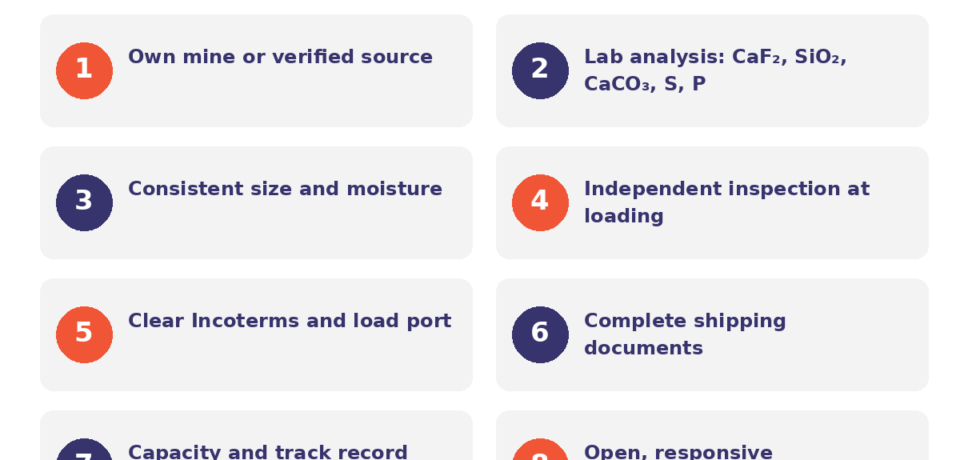
Buying fluorspar is not like buying a branded product off a shelf. Two shipments with the same headline CaF₂ percentage can behave very differently in your furnace or reactor, and a weak supplier can cost you far more than the price difference you saved. This guide gives steel mills, chemical producers, traders and importers a practical checklist for choosing a reliable fluorspar supplier.
If you are new to the mineral itself, start with our guide on what fluorspar is and how it is used, then read what determines fluorspar quality before comparing offers.
1. Check that the supplier controls the source
The first question to ask is whether you are dealing with a producer, an agent or a trader. Each can be legitimate, but a producer with its own mining lease can usually answer detailed questions about the ore, the grading and the production volume.
DKB operates its own mining lease at Village Maiwal, Tehsil Mekhtar, in the Loralai Fluorite Belt of Balochistan, Pakistan’s principal fluorspar-producing region. You can read more about the company on our About Us page and review our certificates and licences.
2. Ask for a full laboratory analysis, not just a grade
A label such as “high grade” tells you nothing. Ask for an analysis that shows at least:
- CaF₂ percentage
- Silica (SiO₂)
- Calcium carbonate (CaCO₃)
- Sulphur and phosphorus
- Moisture
Compare the figures against your own process specification. Steel mills care most about slag behaviour and sulphur and phosphorus limits, while acid-grade buyers need very tight impurity control. Our fluorspar supplier page lists the products we offer, and our current offers range from roughly 60% to 88% CaF₂ in lump and fines. Please contact us for the latest analysis, because grades vary by batch.
3. Confirm size and moisture consistency
Lump size (for example 10–60 mm) and fines size (0–10 mm) change how the material handles and performs. Moisture affects the true weight you pay for and how the cargo behaves in storage. Ask what tolerance the supplier works to and whether sizing can be adjusted to your requirement.
4. Insist on independent inspection
Independent inspection protects both sides. An inspection company such as SGS (or an equivalent) can sample and test the cargo at loading, and the certificate can be used for final settlement. A supplier who is confident in their material will welcome this.
5. Get the commercial terms in writing
Many bulk mineral cargoes are priced CIF (Cost, Insurance and Freight), where the seller arranges ocean freight and marine insurance to your port. Others are FOB, where you arrange the shipping. Make sure the offer states the Incoterm, load port, destination port, quantity tolerance and payment method. The International Chamber of Commerce publishes the official Incoterms rules if you want to check exact responsibilities.
6. Know which documents you will receive
A normal shipment document set includes the commercial invoice, packing list, bill of lading, certificate of origin and a quality or inspection certificate. Your customs broker can confirm what your country requires. Ask the supplier early so there are no surprises at clearance.
7. Check capacity and track record
A supplier should be able to tell you its monthly output, how it handles storage and loading, and which export markets it serves. DKB, established in 2010, produces around 1,000–1,500 metric tonnes per month with processing and export facilities in Karachi and shipments through Karachi Port. You can see our operations on the gallery page.
8. Test communication before you commit
How quickly and clearly a supplier answers your first enquiry is a good preview of how they will handle a shipment problem. Send a precise request (grade, size, quantity, port) and judge the response on speed, detail and honesty.
Fluorspar is not the only mineral we supply
Many industrial buyers source several minerals from one exporter. In addition to fluorspar, DKB supplies:
- Fluorite lumps for industrial use
- Chromite for the steel and ferrochrome sector
- Magnesite for refractory and industrial applications
- Silica quartz for glass, construction and other uses
See the full list on our services page.
Where to learn more
- USGS National Minerals Information Center: fluorspar statistics and information
- More guides on our DKB blog
Frequently asked questions
What should I send to get an accurate fluorspar quotation? Send your required CaF₂ grade, size (lump or fines), impurity limits, quantity, destination port and preferred payment method.
Is fluorspar sold CIF or FOB? Both are common. CIF means the seller arranges freight and insurance to your port, while FOB means you arrange shipping from the load port. Terms are agreed between buyer and seller.
Can I request an independent inspection? Yes. Independent inspection at loading by a company such as SGS is common practice and gives both parties a neutral quality record.
Does DKB supply other minerals? Yes. We also supply fluorite lumps, chromite, magnesite and silica quartz.
How do I contact DKB? Use our contact page, email info@dkbfluoritemining.com or call +92 341 0488892.
Request a fluorspar quotation
Tell us your grade, size, quantity and port, and our team will respond with an offer. Contact DKB Fluorite Mining or email info@dkbfluoritemining.com.